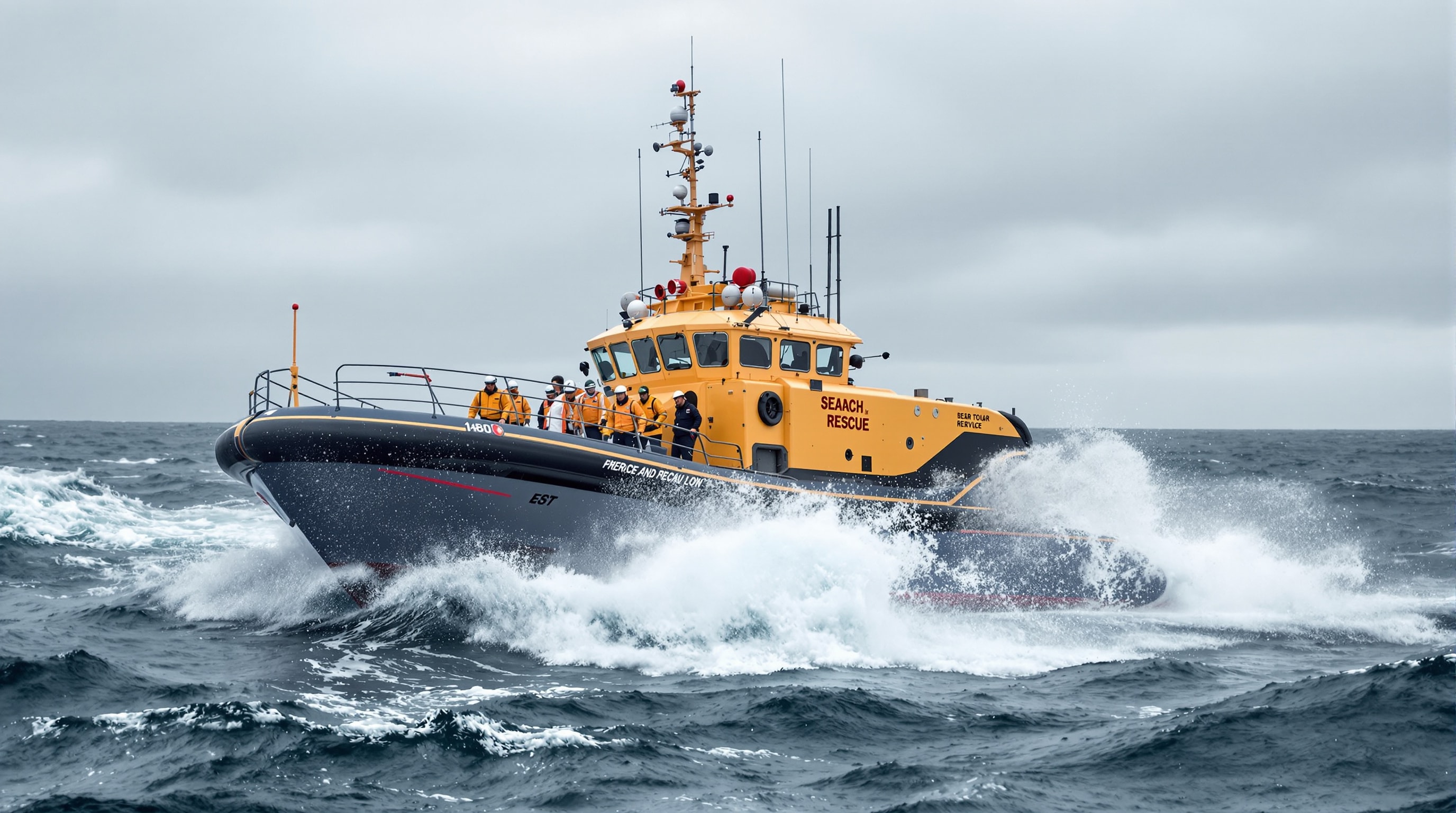
Two boats for two jobs
Most British lifeboat stations, including Eastbourne’s, operate two very different craft. The all-weather lifeboat (ALB) is the big offshore workhorse: a fast, powerful, self-righting vessel that can operate far out to sea in gale-force conditions and stay out for hours. The inshore lifeboat (ILB) is a smaller, highly manoeuvrable inflatable or rigid-inflatable boat, ideal for close-in work near beaches, rocks, the pier and the harbour, and for reaching casualties in shallow water the big boat cannot enter.
Between them, the two boats cover almost any rescue scenario — from a yacht dismasted miles offshore to a swimmer caught by a rip a few metres from the sand. Eastbourne’s lifeboats over the years have followed this pattern as the technology matured.
Built to right themselves
The defining feature of a modern all-weather lifeboat is that it is self-righting. If a wave rolls the boat completely over, its watertight design and weight distribution bring it back upright within seconds, engines still running. That single feature transformed lifeboat safety in the twentieth century, and it is why crews can take these boats into seas that would overwhelm an ordinary vessel. Modern boats also carry radar, satellite navigation, night-vision and casualty-care equipment, effectively a small floating emergency room.
In recent years Eastbourne’s all-weather boat has been a Tamar-class lifeboat — a design capable of around twenty-five knots, with shock-absorbing seats and a computer system that lets the crew monitor and control the boat’s systems from their seats even in violent motion.
Getting the boat to sea
How a lifeboat launches depends on its station. Some lie afloat in a harbour, ready to slip their moorings. Others sit in a boathouse and launch down a slipway straight into the sea. Many inshore boats are launched from a carriage pushed into the surf by a tractor. Eastbourne’s history includes the most dramatic method of all — in the age of oar and sail, boats were sometimes hauled overland by horses to a launching point where the sea would allow it.
Crewed by volunteers
Perhaps the most surprising thing about the lifeboat service is who crews it. The great majority of lifeboat crew members are unpaid volunteers — local people with ordinary jobs who drop everything when their pager sounds. They train for years, in all weathers, for the moments when a stranger’s life depends on their skill. The boats are funded not by government but by charitable donations to the RNLI, which you can read about on our RNLI history page.
What your 999 call sets in motion
When you call 999 and ask for the Coastguard, it is HM Coastguard that decides how to respond — and it can task a lifeboat, a rescue helicopter, or a shore team, alone or together. The crew’s pagers go off; they gather at the station; and within minutes a boat is heading for the position you reported. That is why the early call, and an accurate description of what you have seen, matter so much: they are the first link in a chain that ends with a boat at the casualty’s side.