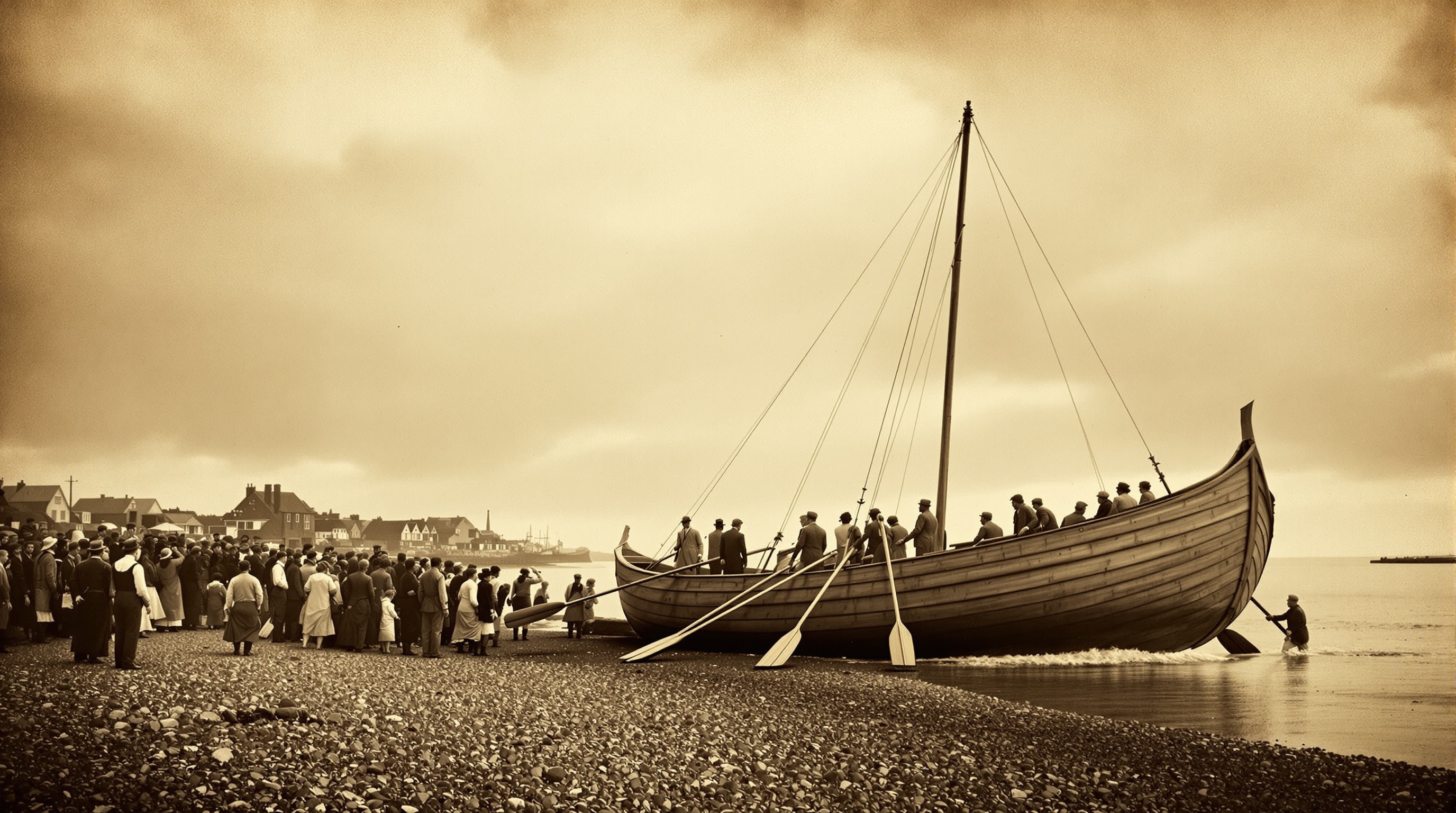
Before the RNLI: the boat of 1822
Eastbourne’s lifeboat story begins in 1822, remarkably two years before the RNLI itself was founded in 1824. The town’s first lifeboat was provided by a local Member of Parliament and landowner of Rose Hill, Sussex — a famously eccentric character — who, on his death in 1833, left the boat “to the inhabitants of Eastbourne.” Built locally, she was twenty-five feet long and pulled ten oars, and she was known by two names: the Samaritan, or The Rose. She served the town until 1863.
In these early decades the boat was a community asset in the truest sense — launched by whoever could be gathered on the beach, in whatever the weather threw at the shore. The national Institution did not formally take over the Eastbourne station until 1853.
The Victorian station takes shape
The middle of the nineteenth century brought new boats and a more organised service. Eastbourne’s second lifeboat, the Mary Stirling, arrived in 1863 as the gift of a benefactor from Cheltenham. The third, The William and Mary, followed in 1881. A bell was placed on the coxswain’s house in 1890 to summon the crew, and a gas service reached the boathouse in 1895 — small modernisations that mark the station’s growing permanence.
There were human costs too. In 1880, as a new lifeboat was drawn in procession through the streets, a small boy named Ernest Best had his foot so badly crushed beneath the carriage that it had to be amputated; the boat’s donor paid all his medical expenses and set aside a sum for his future. It is the kind of detail the official histories often skip — a reminder that these were real crowds, in real streets, celebrating boats they hoped never to need.
The memorial boathouse and the first museum
In 1898 the town gained a new, purpose-built boathouse on the seafront: the William Terriss Memorial Lifeboat House, funded by a public appeal in memory of a much-loved actor. Between 1903 and 1924 two boats were stationed at Eastbourne at once. When the memorial boathouse was retired from active duty, it reopened in 1937 as the first permanent lifeboat museum in the country — a role it still plays today. You can read more about the building on our lifeboat museum page.
Into the modern era
The twentieth century saw Eastbourne move from oars and sail to motor lifeboats, and the town’s boats played their part in the wider national story — including the wartime service of the Jane Holland, linked to the Dunkirk evacuation. In the decades since, the station has operated the familiar pairing used at many British lifeboat stations: a large all-weather lifeboat for offshore work in heavy seas, and a nimble inshore lifeboat for close-in rescues near the beaches, the pier and the harbour.
In more recent years Eastbourne’s all-weather boat has been a Tamar-class lifeboat named Diamond Jubilee — a fast, self-righting vessel packed with navigation and survivor-care equipment. To understand what that means in practice, see our explainer on how modern lifeboats work.
Two centuries, one purpose
Across two hundred years the technology has changed beyond recognition, but the essential thing has not: volunteers, drawn from an ordinary seaside town, putting out into a difficult sea for people they have never met. The tally of gallantry medals won by Eastbourne crews — one Gold, four Silver and five Bronze — is only the formal record of a much larger, quieter history of ordinary courage.