The early gold and silver medals
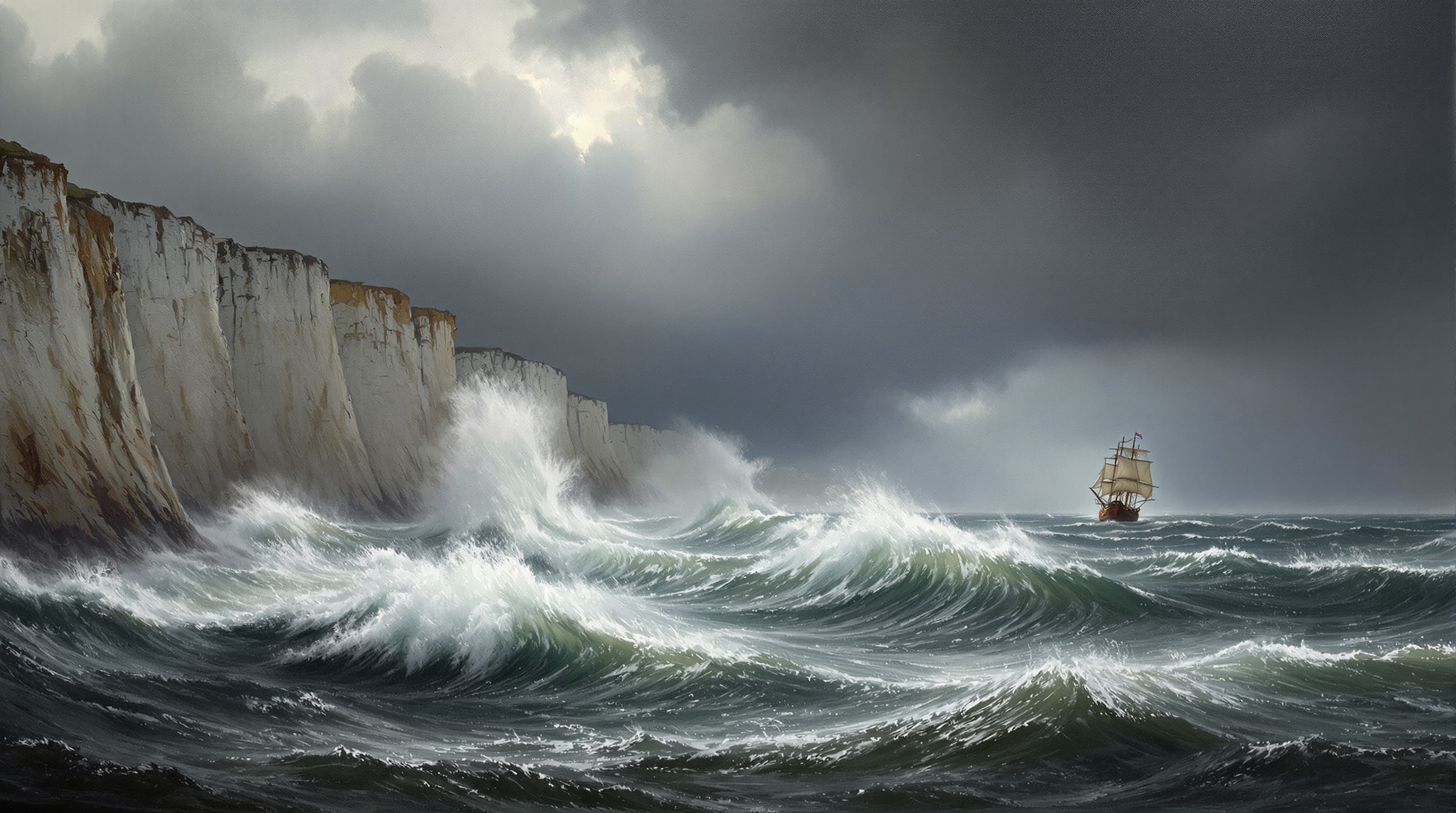
The town’s formal record of gallantry opens in 1824, the very year the RNLI was founded. A Gold Medal — the Institution’s highest award — went to Lieutenant J. Clark RN for the rescue of six people from the brig Juno, wrecked in a storm at Birling Gap on 18 November 1824. It set a pattern that would repeat down the century: a ship driven onto the chalk, and a boat put out to reach her.
More awards followed. In 1840 a Silver Medal was won for saving four men from a French lugger wrecked at Birling Gap in a severe July gale, using the shore-based “Manby apparatus” that fired a line to a stranded vessel. In 1843 Lieutenant J. A. Gilson RN took a boat off to the schooner L’Unione Fortunata, wrecked near Beachy Head, and brought four seamen ashore. Two years later, in 1845, a Dutch relief society added its own silver medals and diplomas after Eastbourne men saved a master and nine crew from a Dutch East-Indiaman.
The New Brunswick and the eight-mile haul
One rescue above all captures the sheer physical effort of the age of oar and sail. On a Sunday in November 1883, in the teeth of a gale and pouring rain, the barque New Brunswick of Norway got into desperate trouble off the cliffs. There was no launching the lifeboat straight into that sea from the town beach — so the boat was taken overland, hauled by horses and helpers along the coast to Birling Gap. The journey alone took two and a half hours before the boat could even reach the water. The crew of eleven were brought safely off.
An earlier overland epic — the 1833 “New Brunswick” service remembered in the museum — had seen a lifeboat towed by relays of horses roughly eight miles to Birling Gap to reach a wreck. These were not one-off heroics but the ordinary logistics of rescue before engines: if the sea would not let you launch nearby, you carried the boat to a place where it would.
War, lighthouses and the modern medals
The twentieth century brought its own chapters. The Eastbourne lifeboat Jane Holland is remembered among the “little ships” connected with the Dunkirk evacuation of 1940. In 1966 the crew carried out a celebrated rescue of a lighthouse keeper off this exposed coast. And as recently as 2002, a medal service to the yacht Paperchase added the most recent gallantry award to the town’s tally — the last of the medals, voted in 2003.
In all, Eastbourne crews have been awarded ten RNLI medals for gallantry over the years: one Gold, four Silver and five Bronze. Every one was granted by the RNLI, and each marks a service in which volunteers accepted real danger on behalf of strangers.
Why this coast is so demanding
The recurring place-names in these stories — Birling Gap, Beachy Head — are no coincidence. The chalk headland and the tide-swept ground beneath it have always been among the most hazardous on the south coast for sailing vessels, and remain a focus of rescue work today. Understanding that coast is the subject of our Beachy Head and Birling Gap page, and the reason the safety advice on the rest of this site matters so much.